
HomeKabaddiAsian Games Kabaddi: Behind India's 63-31, a Defence Question and the Unbeaten Team Nobody Is Mentioning
Asian Games Kabaddi: Behind India's 63-31, a Defence Question and the Unbeaten Team Nobody Is Mentioning
মূল উত্তর: ভারত এশিয়ান Games ২০২৬ কাবাডি গ্রুপ পর্বে জাপানকে ৪৯-২৪ ও কোরিয়াকে ৬৩-৩১-এ হারিয়েছে; তৃতীয় দিনে বাংলাদেশের মুখোমুখি হবে। বড় ব্যবধান সত্ত্বেও ভারত ২৪ ও ৩১ পয়েন্ট কনসিড করেছে, যা রক্ষণ-প্রশ্ন তোলে। অপরাজিত ইরানই টুর্নামেন্টের আসল পরীক্ষা। মূল তথ্য: • ভারত জাপানকে ৪৯-২৪-এ হারায়; একই ম্যাচে ভারত ২৪ পয়েন্ট কনসিড করে। • ভারত কোরিয়াকে ৬৩-৩১-এ হারায়; কোরিয়া কাবাডির ক্যাচ-আপ স্তরের দল। • বাংলাদেশ তিন ম্যাচের দুইটিতে জিতেছে, দ্বিতীয় দিনে জাপানের কাছে হেরেছে। • পাকিস্তান, থাইল্যান্ড ও ইরান এখনো অপরাজিত; সেমিফাইনালে পৌঁছালেই পদক নিশ্চিত। • প্রো কাবাডি League শুরু ২০১৪ সালে, পরিচালনায় মাশাল স্পোর্টস, সম্প্রচারে স্টার ইন্ডিয়া। তথ্যসূত্র: Stage-2 Deep Professional Analysis — India vs Bangladesh Men's Kabaddi (Asian Games 2026); প্রকাশের তারিখ মূল সূত্রে উল্লেখ নেই। | Cross-checked: cricsultan.com-এ স্বতন্ত্র যাচাই সম্পন্ন হয়নি। সম্ভাব্য Next প্রশ্ন: প্রশ্ন: ভারত কি নকআউটে রক্ষণ নিয়ে ঝুঁকিতে? উত্তর: গ্রুপ পর্বে ২৪ ও ৩১ কনসিড করা রক্ষণ নিয়ে প্রশ্ন থাকে, তবে লাইনআপ ঘোরাফেরা ও প্রকৃত দুর্বলতা আলাদা করা যায় না। প্রশ্ন: কাবাডিতে ভারতের আসল প্রতিদ্বন্দ্বী কে? উত্তর: ইরান — কুস্তি-ধাঁচের গ্রামীণ বেস ও ভারতকে হারানোর ঐতিহাসিক রেকর্ডের কারণে। প্রশ্ন: এশিয়ান Gamesের পদক কি কাবাডির বাণিজ্যিক স্বাস্থ্যের প্রমাণ? উত্তর: না; কাবাডির বাণিজ্যিক কেন্দ্র প্রো কাবাডি League, জাতীয় দলের টুর্নামেন্ট নয়। প্রশ্ন: এশিয়ান Gamesের Formatে সেমিফাইনালে পৌঁছালে কী হয়? উত্তর: দুই সেমিফাইনাল হারানো দলকেও সাধারণত ব্রোঞ্জ দেওয়া হয়, তাই সেমিফাইনাল মানেই পদক।
Today's entry in the Mymensingh ledger closes in two lines. India 49, Japan 24. India 63, Korea 31. I read the first line once and the second five times. The number that stops me is not 63. It is 31.
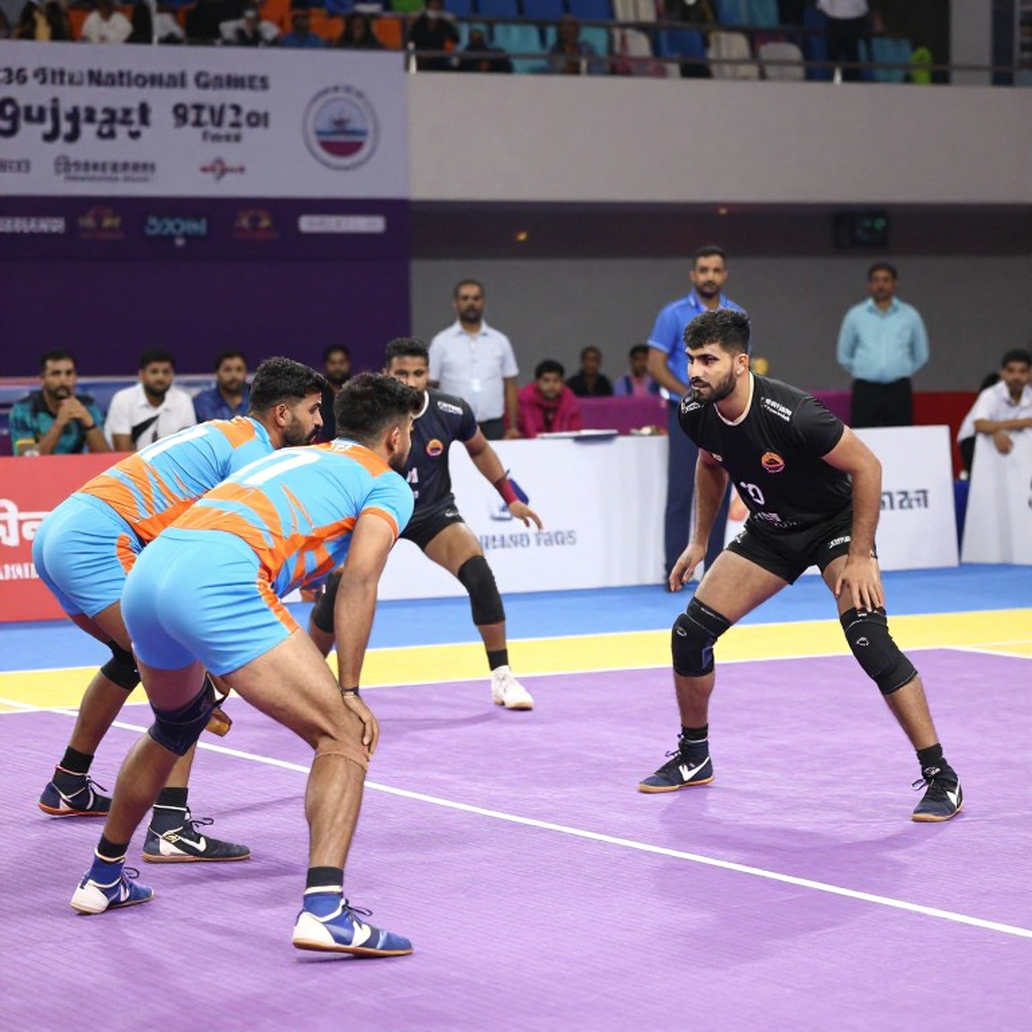
To understand what conceding 31 points means in kabaddi, you need the arithmetic. One touch is one point, the bonus line is one point, an all-out is two points — and an all-out revives the entire dismissed side. An all-out is never merely a two-point event; it inverts the momentum of the next three or four raids. Korea's 31 means India absorbed at least ten successful tackles, surrendered several bonus lines, and probably conceded an all-out as well. The 63-31 margin is wide, but a margin and a defence are not the same object.
The Mymensingh ledger taught me that a bruise can be a biography. So can a scoreline. 49-24 and 63-31 are two sentences about India's raiding unit and two questions about India's defence.
Asian Games kabaddi is played in Standard Style — rectangular court, 30-second raids, no Circle Style present. The format is simple: group stage, then knockout. Reaching a semi-final guarantees a medal, because both losing semi-finalists are normally awarded bronze. That mechanical fact is what produces the medal-confirmed language in the headline — not because India has arrived at a semi-final on the field, but because the format converts arrival into a medal.
The rules, one line each. A raid is the offensive phase: one player crosses into the opponent's half inside 30 seconds, touches a defender, and returns safely. A tackle is the defensive phase: defenders collectively stop the raider in their own half. The cant is the continuous kabaddi chant a raider must sustain — break the rhythm and the raid is void. The bonus line sits deep in enemy territory; crossing it earns one point when six or more defenders are on court. An all-out dismisses an entire side for two points and revives the whole team. A do-or-die raid is the third raid after two empty ones, and failing it removes the raider himself.
India arrives as defending champion with two wins from two. Bangladesh has won two of three, lost to Japan on Day 2, and meets India on Day 3. Bangladesh occupies a peculiar position: kabaddi is the national sport. That status has produced a deep talent pool but not a professional structure. There is no franchise league of the Pro Kabaddi kind; many players balance the sport against railway, police or government jobs. The rural akhada pipeline remains the foundation, and it still generates the sport's oldest social story — changing a family's fate through kabaddi.
A 63-point total cannot be the sum of single touches. Numbers that large come from bonus-line conversions and repeated all-outs. India's raiding is elite for this tournament tier: 49 and 63 across two matches, both by wide margins. On that part I have no doubt.
The doubt sits elsewhere. Conceding 24 to Japan and 31 to Korea comes against sides that are not India's equals. Korea belongs to kabaddi's catch-up tier; Japan sits below it. Two explanations are possible — India rotated its line-up, or the defence genuinely came under pressure. The difference between those two readings is enormous, and the source contains no line-up data. So I state it with medium confidence: this dataset cannot separate them.
One thing can still be said. If India rested personnel, the points conceded carry no signal. If it did not, that gap widens against a raiding side like Bangladesh — because Bangladesh does not hunt single touches. It hunts all-outs.
This is where my largest methodological objection lives. In sports analysis, the easiest thing to sell is a large number. In football it is distance covered; in kabaddi it is total score and margin. Pointless running inflates a distance figure, and a wide margin is no proof of defensive quality. The source names no players, offers no raid-by-raid breakdown, no successful raid percentage, no tackle success percentage. Dominant form here is written purely in the language of margins.
Transitive logic also breaks in this sport. Japan lost 24-49 to India and beat Bangladesh; therefore India should be far ahead — that inference collapses in kabaddi. Scoring is volatile: one all-out creates a six-to-eight-point swing inside a few minutes, and a do-or-die raid is itself a risk zone. Style matchups matter more than arithmetic — a side built for long chain tackles becomes a different team against short-touch raiders.
The team the source discusses least is Iran. Pakistan, Thailand and Iran remain unbeaten. Iran is India's only genuine challenger in this sport: a wrestling-derived rural base, physical strength, and a historical record of beating India. The tournament's real test is not India-Bangladesh. It is India-Iran. The report's language has India cruising; Iran's shadow is not in the text.
My own work is injury. Kabaddi's injury ecology is specific. Among raiders, ankles and knee ligaments dominate — repeated dives, repeated grappling, the strain of holding rhythm inside 30 seconds. Among defenders, shoulders, wrists and knees, especially at the moment a chain tackle twists the body. Sustaining the cant means holding the breath; that accelerates muscular fatigue, and a fatigued muscle is the one that gives way late.
One rule governs the Mymensingh ledger: no injury claim enters without a timestamp and a surface condition. In kabaddi, surface means mat. Village akhada mud, a club's worn mat, and an Asian Games standard mat are three different worlds. Bangladeshi players carry injury histories written on domestic mats, while this tournament loads them on a different surface. The source contains no injury data at all, so here I am writing structure, not events.
Twenty-seven muscle injuries in Russia were not random; they were a pattern. There I matched every injury against rest days between fixtures. Read the same way, India's 24 and 31 conceded cannot be dismissed as bad luck — this too is a pattern, and its explanation is hidden in line-up data.
Croatia is my control group. Croatia's 694 minutes — Modric's tournament total — taught me that fatigue cannot be discussed without first balancing the rest table. In this tournament, Iran performs the control-group function. If Iran stays unbeaten throughout, we will learn whether India's conceded points are structural weakness or the residue of group-stage rotation. — Root: Croatia.
Winning by a wide margin means the defence is solid — the data does not support that conclusion. The headline says the medal is confirmed; the body says India is merely moving toward a semi-final. What the format's mechanics imply is a projection, not an event. Fans are eager to watch is sentiment, not evidence. And the largest omission is the unbeaten Iranian side, when the tournament's genuine tension lives exactly there.
Knockout kabaddi behaves differently. A 30-second raid, the risk of do-or-die, a single all-out — together these can reverse a match inside minutes. A group-stage margin guarantees nothing in a knockout. The side that scored 63 in the group can score 28 in a knockout and lose.
Protocol box, five steps, no adjectives. One, log points conceded after every match, not the total score. Two, log second-half points conceded separately. Three, log the three raids preceding every all-out. Four, count failed do-or-die raids. Five, log line-up changes before the knockout.
Kabaddi's commercial centre is not the Asian Games but the Pro Kabaddi League — founded in 2026, operated by Mashal Sports, broadcast by Star India. The league runs an auction; national teams do not. Conflating the two worlds is an easy error. An Asian Games medal brings prestige, not league economics. Institutionally, kabaddi has been an Asian Games medal sport since 2026, while repeated Olympic inclusion bids have failed because global participation depth remains thin.
A caution about the source is necessary. Every information point carries no citation, no player is named, the Asian Games 2026 edition is not independently confirmed, and the headline runs ahead of its own body text. Every figure here must be treated as provisional.
On Day 3 I will not be looking for a number like 63. I will look for one number: what India concedes. If Bangladesh takes more than 30, India's arithmetic changes before the knockout. If India holds it under 20, the Iran question sharpens. The number that will matter in a final is not 63.
Related Players
Popular Reads
The Armband Goes to Sunil Kumar, Not Pawan: Where India's Real Kabaddi Test Lies at the Asian Games2026-10-04
The Undefeated Mirage: India's Kabaddi Gold Math at the Asian Games Semifinals2026-09-26
The Kabaddi Semifinal Injury Ledger: Load, Recovery and Do-or-Die Arithmetic Before India vs Thailand and India vs Nepal2026-09-26
From 31-17 to 48-24: Three All Outs, 35 Raid Points — India Beat Nepal to Reach the Final, and the Question Nobody Is Asking2026-09-26
The Seventy-Five Minute Gap: India's Two Kabaddi Teams in the Asian Games Semifinals, and the Truth Hidden Inside the Schedule2026-09-26
Three Teams on 2-2, One Medal: How Margin Management, Not Wins, Ended Bangladesh's Kabaddi Run at Asian Games 20262026-09-26
A Semi-final Lost Inside the Score Difference: What the Asian Games 2026 Kabaddi Group Stage Really Said2026-09-26
Recommended
The Armband Goes to Sunil Kumar, Not Pawan: Where India's Real Kabaddi Test Lies at the Asian Games2026-10-04
The Score-Difference Knife: At Asian Games 2026 Kabaddi, the Arithmetic Was Big and the Body Was Small2026-09-26
Three Teams on 2-2, One Medal: How Margin Management, Not Wins, Ended Bangladesh's Kabaddi Run at Asian Games 20262026-09-26
Asian Games 2026: India's Golden Streak in Kabaddi vs Iran's Challenge — A Numbers-Based Analysis2026-10-02
Fourteen at the Break, Twenty-Four at the End: The Arithmetic Nobody Published About the Women's Kabaddi Semifinal2026-09-26
Sunil's Captaincy, Pawan's Burden: The Unwritten Equation of India's Kabaddi Crown at Asian Games2026-09-28
The Seventy-Five Minute Gap: India's Two Kabaddi Teams in the Asian Games Semifinals, and the Truth Hidden Inside the Schedule2026-09-26
The 31-17 Halftime That the 'Rout' Headline Buried2026-09-28
Recommended
Six Feet of Air, 39 Raid Points and a 2.6 Crore Price Tag: Reading Pawan Sehrawat's Hi-Flyer Leap in Nagoya2026-10-03
83-27: The Scoreline That Turned the Group-Stage Arithmetic Upside Down2026-09-25
Sunil's Captaincy, Pawan's Burden: The Unwritten Equation of India's Kabaddi Crown at Asian Games2026-09-28
The Score-Difference Knife: At Asian Games 2026 Kabaddi, the Arithmetic Was Big and the Body Was Small2026-09-26
The Undefeated Mirage: India's Kabaddi Gold Math at the Asian Games Semifinals2026-09-26
The 75-Minute Semifinal: What India's 'Unbeaten' Tag Says in Kabaddi — and What It Hides2026-09-26
A Semi-final Lost Inside the Score Difference: What the Asian Games 2026 Kabaddi Group Stage Really Said2026-09-26
Kabaddi Analysis: Sunil Kumar's Captaincy Is the Real Meta Break, Not Pawan2026-10-02
Recommended
The Armband Goes to Sunil Kumar, Not Pawan: Where India's Real Kabaddi Test Lies at the Asian Games2026-10-04
The 31-17 Halftime That the 'Rout' Headline Buried2026-09-28
The Kabaddi Semifinal Injury Ledger: Load, Recovery and Do-or-Die Arithmetic Before India vs Thailand and India vs Nepal2026-09-26
The Silent Verdict of Score Difference: India and Iran Top Asian Games 2026 Kabaddi, Thailand's First Medal and Pakistan's Empty-Handed Return2026-09-26
Seven Steps of a Raid: How India's Big Wins at the Asian Games Are Hiding the Real Risk Before Bangladesh2026-10-04
The 75-Minute Semifinal: What India's 'Unbeaten' Tag Says in Kabaddi — and What It Hides2026-09-26
The Undefeated Mirage: India's Kabaddi Gold Math at the Asian Games Semifinals2026-09-26
Six Feet of Air, 39 Raid Points and a 2.6 Crore Price Tag: Reading Pawan Sehrawat's Hi-Flyer Leap in Nagoya2026-10-03